 TheVetCSR
Blog / Front Desk Playbook
The Second-Opinion Call: Make It Normal, Carry the Question, Never Play Doctor
A worried client calls for a second opinion and apologizes for asking. Make it normal, take the story in their words, carry their one question into the room, get records with permission, and book anyway.
You can hear it before they finish the sentence. The voice gets a little smaller. "Hi, um, I have a question, and I hope this is okay to ask." Then they apologize for calling. They apologize, basically, for existing.
That is the second opinion call. A client already has a vet, and they feel like they are cheating on them just by dialing your number. Your first job is not booking. Your first job is taking the guilt off the table, so they can actually talk.
This playbook comes from the October 27 episode of TheVetCSR Daily, Front Desk File 2, blown up into the full desk system. Mr. Whitfield and his senior tabby Juniper are fictional teaching examples from the episode. Another clinic told him they want to watch a lump they found, and he wants another set of eyes on it. He is not angry at the other clinic. He is worried, and worry sometimes needs a second conversation.
Why this call is hard (and it is not the schedule)
A second opinion caller is carrying two worries at once. Worry about the pet, and worry about being disloyal. If you only answer the scheduling worry, the loyalty worry stays in the room and does the damage. That is the caller who books, then cancels before the visit, because guilt talked them out of it. That is the caller who sits in the exam room with their mind blank, because nerves ate every question they meant to ask.
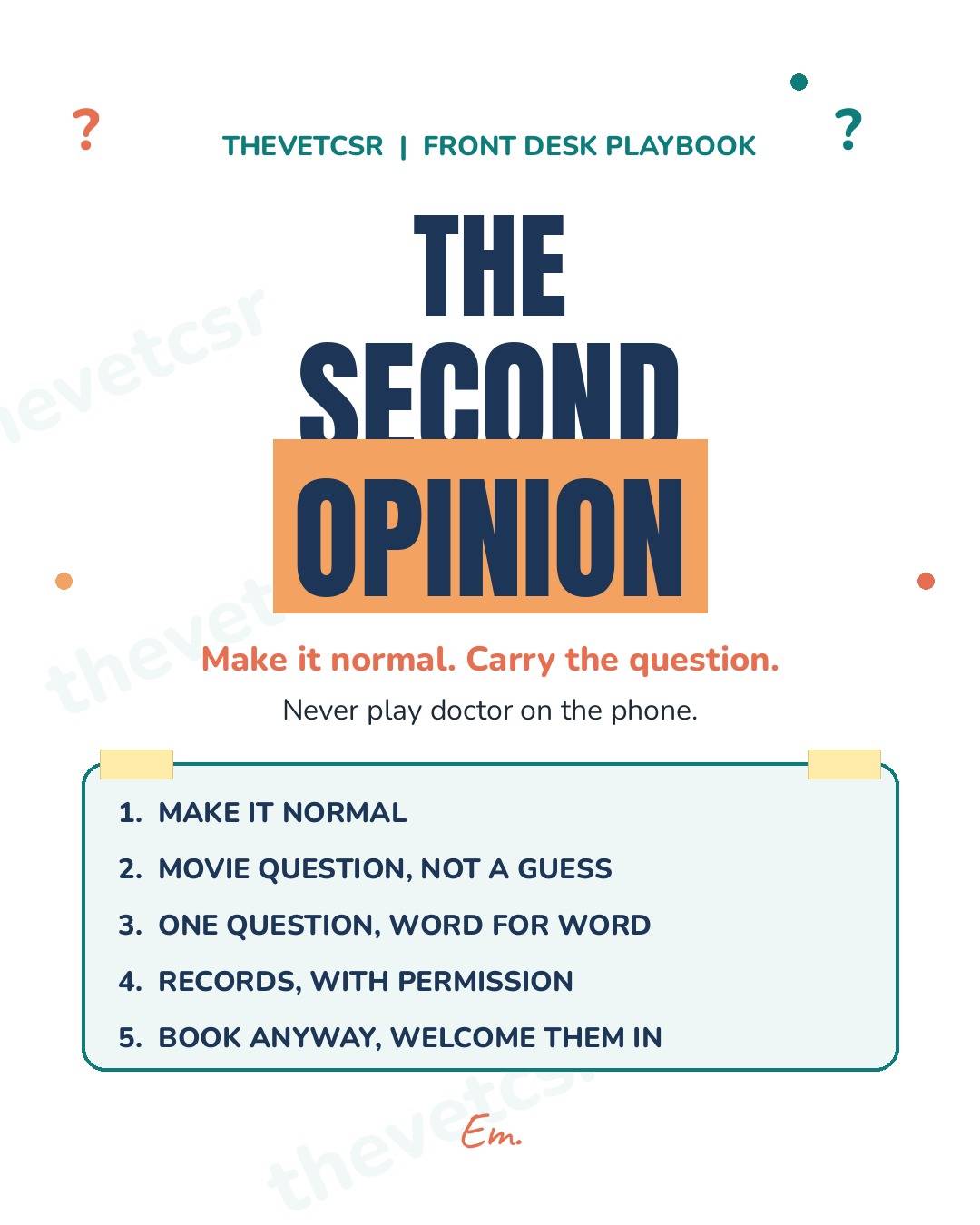
So the whole system has one idea underneath it: make it normal, take the story in their words, carry their one question into the room, get records with permission, and never play doctor on the phone. Do those five things, and a nervous caller becomes a prepared client. Skip one, and you will feel it later, in a missing record, a blank exam room, or a visit that felt like a waste.
Move 1: Make it normal, out loud
Do not wait for them to work up to the ask. Say it first, plainly, in the first minute.
"Of course it is okay to ask. People call us for second opinions all the time. You are doing the right thing by asking questions about your pet."
That one sentence does real work. It tells them they are not the first person to make this call, they are not betraying anyone, and asking questions is care, not disloyalty. Say it like you mean it, because if you rush past it, they hear the rush, and the guilt stays.
Notice what is not in that sentence. No opinion about the other clinic. No opinion about the lump. No promise about what your doctor will say. Just permission to be here. Permission is the whole first move.
Move 2: Ask the movie question, not the review question
Do not ask, "What do you think is wrong with her?" That question asks a worried owner to do the doctor's job, and it hands you a guess dressed up as a history. Ask the movie question instead: what are you seeing, and when did it change?
"Tell me what you are seeing with Juniper. What changed, and when did you first notice it?"
Then let them tell the story in their own words. How she is eating, how she is moving, what the lump feels like to them, when it showed up. Write it down in their words, in quotes where it matters. "Lump feels bigger this week, she is sleeping more, still eating fine." That note is gold in the exam room, because it is the owner's observation, not your translation of it, and the doctor can work with observations.
This is also where the CSR scope line lives, and it is worth saying straight. You are collecting, not deciding. You take the history. The team decides what it means. A guess from the front desk becomes a diagnosis in the client's head, and you cannot take it back, so do not offer one, even if you have seen a hundred lumps and you have a feeling about this one.
Move 3: Carry their one question into the room
After the story, ask the question that saves everybody time later.
"If the doctor could answer one question for you at this visit, what would it be?"
Write that question down exactly. Word for word. Because when Mr. Whitfield walks in nervous, and the doctor asks what brings him in, and his mind goes blank, that note is his voice when he cannot find it. Hand it to the team before the visit, and flag it: this is the question he came in with.
One question, not five. Five questions scatter. One question focuses the visit, and it tells the client you were actually listening, because you wrote down the thing that scared them most, not just the appointment time.
Move 4: Records with permission, and book anyway
This is where second opinion calls get sticky, so slow down here. Ask, do not assume.
"Would you like us to request Juniper's records from your other clinic? We can do that with your permission, and it helps the doctor see the full picture."
If they say yes, take down the clinic name, and tell them the honest timeline. "Sometimes records take a few days, so we will book your visit and keep an eye out for them. If they have not arrived by then, we will still see you, and the doctor will work with what we have."
Three parts, none of them optional. Permission first, because records move on the client's say so, not on your efficiency. Honesty about timing second, because nothing is worse than a client who thinks the records are definitely coming, and then they are not, and the visit feels like a waste. Book anyway third, with a note that records are pending, and tell the team. That is the whole system.
The professional guidance backs this shape up. The Alberta Veterinary Medical Association's second opinion protocol says appropriate permissions should be obtained from the client before records are released to the second opinion veterinarian, and that it is professional courtesy for the second veterinarian to inform the first veterinarian they are seeing the case, after obtaining owner consent. Your desk version of that is simpler: permission, request, note it, tell the team, and let the doctors handle doctor to doctor communication. AVMA's client management guidance says the same thing from the records side: provide copies of medical records to the client upon request or if required by law, and do not release originals. Copies move. Originals stay. Your clinic's written protocol wins on the exact form, every time.
Move 5: The welcome that calms them down
End with what happens next, because a nervous client who knows what happens next is a calmer client. That is not small talk. That is care.
"Bring any paperwork you already have, even if it is just a vaccine card. Arrive a few minutes early, and we will get Juniper checked in and settled. The doctor will start with your questions."
Paperwork they already have, not paperwork they have to chase. A few minutes early, not a lecture about lateness. And the last line is the one that matters: the doctor will start with your questions. That tells them the question you wrote down in Move 3 is not sitting in a file somewhere. It is going into the room with them.
The branches: where this call actually gets tested
The five moves are the straight line. Real calls branch. Here are the four branches that come up most, with the exact shape of the answer.
Branch 1: They start badmouthing the other clinic
"They never listen, they rushed us, they do not care." It is tempting to agree. It feels like loyalty to your new client. Do not do it.
"I am sorry that visit felt rushed. Let us make sure you get plenty of time here to ask your questions."
You validate his feeling without passing judgment on another clinic. You have not seen their chart. You do not know their day. And honestly, the client notices when you stay classy about it. It makes him trust you more, not less. Agreeing feels good for ten seconds and costs you credibility for the whole relationship.
Branch 2: They ask you what you think
"Do you think I should be worried? Do you think it is serious?" This is the branch that tests your discipline, because you probably do have a feeling, and the client is begging you to say it.
"That is exactly the kind of question the doctor will want to dig into with you. Let us get you in, and bring that question with you."
Same shape, every time. No ranking the lump. No reassurance. No "I have seen this before, it is usually fine." Reassurance on the phone is a medical answer in a friendly voice, and it is not yours to give. Carry the question to the doctor instead. That is the job.
Branch 3: They already told the other clinic they are leaving
Now they feel awkward about it, like they burned a bridge just by asking a question. Give them the permission they did not know they needed.
"You do not owe us an explanation, and you do not owe them one either. You are allowed to get a second opinion and still go back. Plenty of people do."
That permission matters, because guilt makes people cancel the second visit before they ever get there. Saying "you can still go back" does not lose you the client. It keeps them, because a client who feels trapped does not come back either. A client who feels free to choose, and chooses you, stays.
Branch 4: They go back to the other clinic in the end
It happens, and it is fine. Say so, kindly, on the way out.
"We are glad we got to meet Juniper, and the door is open if you ever need us again."
A client who leaves kindly is a client who refers friends. A client who leaves feeling judged tells a very different story. The door back in is not a consolation prize. It is the last impression, and last impressions travel.
What the front desk never says on a second opinion call
- Never "That does not sound serious." That is a diagnosis, and it is not yours. Report what the owner sees. Let the team decide what it means.
- Never "Your other vet was wrong." You have not seen their chart, their exam, or their day. Validate the client's feeling, never judge the other clinic.
- Never "We will definitely get your records." Records take time, and sometimes they do not arrive. Promise the request and the visit, not the delivery.
- Never "You should switch to us." A second opinion is not a sales call. The client chose your clinic for the scariest question they have. Treat that like the compliment it is, not a closing opportunity.
- Never "Do not tell your other vet." Secrecy makes a worried client more worried. Permission, honesty, and doctor to doctor communication are the system. Work inside it.
The chart note: three lines, written before you hang up
Write the note while the call is fresh, in this shape, every time:
Second opinion visit, records requested with permission (pending / received).
Owner's story, in their words: [what they see, when it changed].
One question for the doctor: [their exact question].
Example, using the episode's fictional caller:
Second opinion visit, records requested with permission from [other clinic], pending.
Owner's story, in his words: lump being watched elsewhere, worried, wants another set of eyes.
One question for the doctor: [whatever Mr. Whitfield actually said, word for word].
Notice what the example does not do. It does not fill in a question he never asked, and it does not summarize his worry into your words. The note is his voice, carried into the room. If the note is vague, the visit starts vague. If the note is exact, the doctor starts with the right question.
For practice managers: make this call boring, on purpose
A second opinion call should not depend on which CSR answers the phone. Put the five moves on one card at the desk: make it normal, movie question, one question, records with permission, welcome. Put the never says on the back. Then audit one thing for a month: how many second opinion visits arrived with records pending and no note telling the team? That number is your system, not your staff, and it is fixable with a card and a habit, not a lecture.
One more manager note. The receiving veterinarian's job, in the professional guidance, is an independent assessment of the current picture and a forward looking plan, not a verdict on the first veterinarian's judgment. Your front desk version of that is the same: do not sell a verdict, book an assessment. Clients who hear "we will take a fresh look and answer your question" trust you more than clients who hear "we will tell you if they were wrong."
Start with the next caller, not a new system
You do not need a new form to run this. The next time a voice gets small on the phone and apologizes for asking, say the normal sentence first. "People call us for second opinions all the time." Ask the movie question. Write down their one question, exactly. Ask about records, with permission, and book anyway. Welcome them with what happens next.
That caller is not a difficult client. That caller is a worried client who chose your clinic for the scariest question they have. Make it normal, carry the question, and let the doctor do the medicine. That is the whole playbook, and it fits on an index card. Tape it to the phone if you have to.
The takeaway
Make it normal. Take the story in their words. Carry their one question into the room. Request records with permission, and book anyway. Never trash another clinic, and never play doctor on the phone. A worried client who chose your clinic is a compliment. Treat them like one, from the first small voice on the phone to the door you leave open on the way out.
Keep these scripts on your desk
If the hard calls are the ones that unravel your team's day, the word for word scripts live in the Phone Script Cards on the TheVetCSR Etsy shop, and the full new hire phone training, including the hard calls, is in the Training Guide and Call Scripts. Both are printable, both are written for the desk, not the textbook.
More front desk playbooks live on the blog: thevetcsr.com/blog, with earlier posts in the archive at thevetcsr.blogspot.com. Listen to the episode this post is built from on the TheVetCSR podcast, watch on YouTube, and follow the page at facebook.com/thevetcsr. The shop is at thevetcsr.etsy.com.
Sources
- TheVetCSR Daily, October 27, 2026 episode, Front Desk File 2, the second opinion call (Mr. Whitfield and Juniper are fictional teaching examples from the episode; the five moves, branches, never says, and chart note shape are TheVetCSR originals).
- Alberta Veterinary Medical Association, Council Guideline for Consultation, Referral or Owner Initiated Second Opinion (appropriate permissions obtained from the client before records are released to the second opinion veterinarian; professional courtesy to inform the initial veterinarian, after owner consent): abvma.in1touch.org
- AVMA PLIT, Client Management Guidelines (provide copies of medical records to the client upon request or if required by law; do not release original medical records or radiographs): avmaplit.com
- AVMA, Principles of Veterinary Medical Ethics, Veterinarian-Client-Patient Relationship (the veterinarian assumes responsibility for medical judgments, has sufficient knowledge of the patient, is available for follow up, and maintains patient records): avma.org
Scope note: this is a front desk communication playbook, not medical advice. The CSR's job is to take a clean history in the owner's words, document it where the team can see it, request records with the client's permission, and escalate to the veterinary team. Diagnoses, second opinion judgments, and treatment plans belong to the veterinarian, and your clinic's written protocols always win.