 TheVetCSR
Blog / Front Desk Playbook
The Lab Results Call: Be the Messenger With a Door, Not the Interpreter
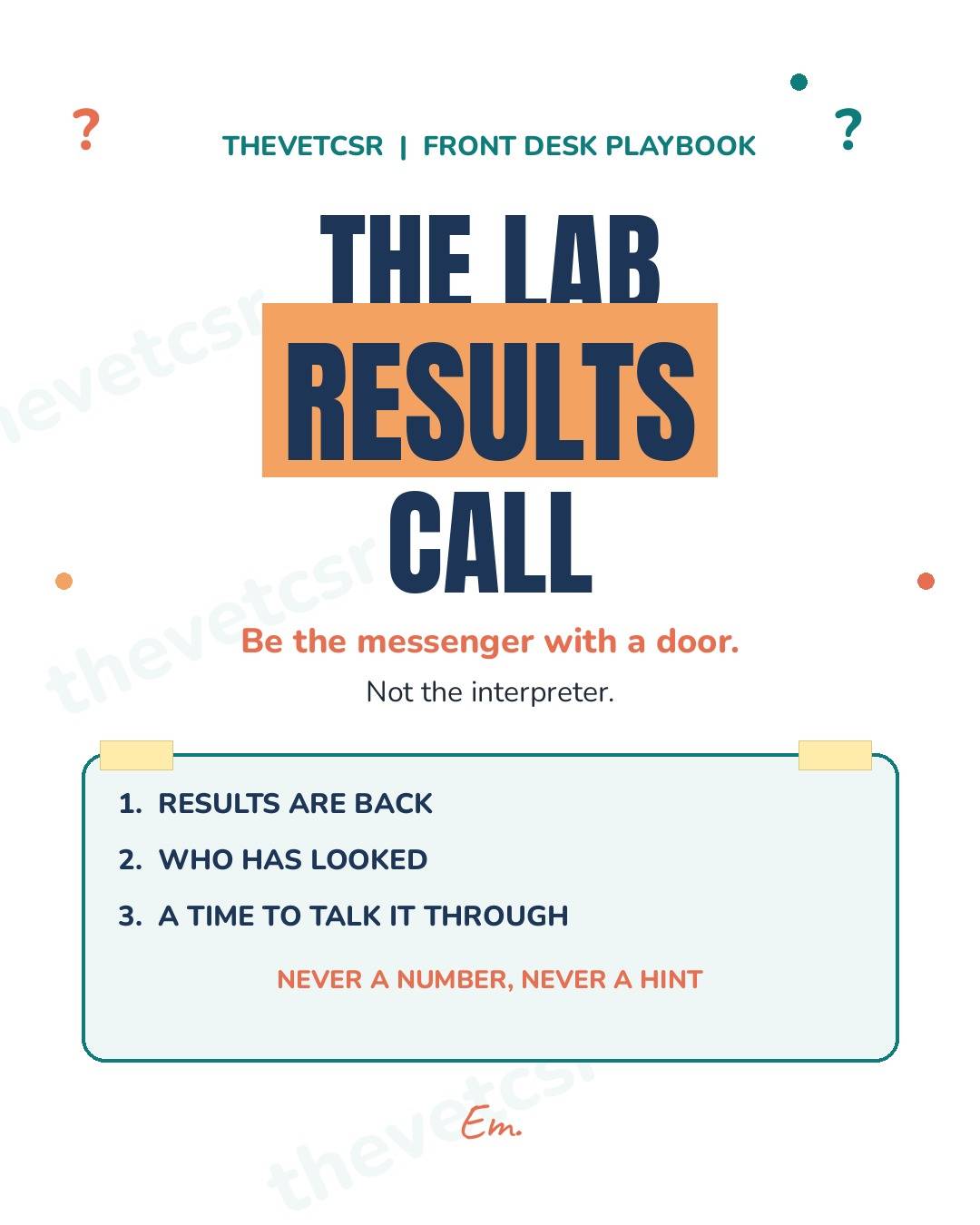
Pepper's bloodwork is back and Mrs. Hartley wants to know what it says. Tell her the results are back, tell her who has looked, and give her a time to talk them through. Never a number, never a hint.
The results are sitting right there on your screen. The owner has been waiting days for this call. You pick up the phone, and you can feel the whole call wobble on the first sentence, because you know exactly what she is about to ask, and you know you cannot answer it the way she wants.
That is the lab results call. It makes good CSRs nervous for a good reason. The owner wants an answer, the answer is on your screen, and your job is to not give it. Not because you are being difficult. Because a number without the doctor is not information. It is a worry dressed up as information, and it will run wild the second you hang up.
This playbook comes from the October 28 episode of TheVetCSR Daily, Front Desk File 1, blown up into the full desk system. Mrs. Hartley and her cat Pepper are fictional teaching examples from the episode. Pepper had bloodwork done, and Mrs. Hartley wants to know what it says. Everything below, the three jobs, the branches, the never says, the chart note, is built from that call.
The three jobs, and only the three jobs
A results call has three jobs. Tell her the results are back. Tell her who has looked at them. Give her a time to talk them through. That is it. That is the whole job, and it is a good job.
Notice what is not on the list. Explain a value. Reassure her. Read numbers off the page. Rank how worried she should be. None of that is the front desk job, and every one of those is a trap that looks like being helpful. Being helpful on this call means getting her to the person who can actually explain the results, with a time on the calendar and a note the team can see.
AAHA's whole team communication guidance makes the same distinction from the other side of the desk: messages should stay consistent no matter who delivers them, and team members who are not comfortable answering a specific question direct the owner to ask the veterinarian. That is not passing the buck. That is the system working. Your tone on this call is not a test result. Do not let it become one.
The opener: where things stand, nothing more
Do not open with a number. Do not open with a word like normal or worrying. Open with where things stand.
"Hi, Mrs. Hartley, this is Reese from the front desk. I am calling because Pepper's results are back, and the doctor has had a look at them."
That one sentence does so much work. Results are back, the doctor has looked, and you are the person connecting her to the next step. Then give her the door, not the answer.
"The doctor would like to go over them with you, so let us find a time for you to come in and talk it through."
Say it like that, and the call has a shape. She knows what happened, she knows who has seen it, and she knows what happens next. Most of the panic in this call comes from the owner not knowing those three things. Give them to her in the first thirty seconds, and the rest of the call gets easier.
The branches: where this call actually gets tested
The opener is the straight line. Real calls branch. Here are the five branches that come up most, with the exact shape of the answer.
Branch 1: She presses for a hint
She will. She will say, "Just tell me, is it bad? Just give me a hint." Every time. And this is the branch where warm and in your lane have to happen in the same breath, because a lecture about scope will make a scared person feel dismissed, and a hint will make her feel reassured about something you do not actually know.
"I hear you, I really do, and I do not want to guess at something this important. That is exactly why the doctor wants to talk it through with you."
Then do not leave her hanging there. Move straight to the next real thing.
"I have got an opening later this week, would that work for you, or do you want me to check on something sooner?"
A worried person does not need a lecture about scope. She needs a time, a plan, and a person. Give her all three, and the hint stops mattering, because she has something better than a hint. She has an appointment.
Branch 2: She wants the results by email
"Can you just email me the results? I will read them myself." This one is a team question, not a yes on the phone. Sharing results is governed by your clinic's protocol, and the rules vary by state and practice, so the front desk answer is never a blanket yes or a blanket no.
"Let me check how the doctor wants those shared, and I will get back to you with what we can send and when."
And write that down, word for word. Not "wants results." Write "asked for results by email, waiting on team direction, callback promised today." Because "wants results" tells the next person nothing. The exact ask tells them everything.
The professional guidance behind this branch is worth knowing, not quoting at the owner. AVMA PLIT's client management guidance says to provide copies of medical records to the client upon request or if required by law, and never to release the original records. A copy for the owner, with the doctor's direction on how it goes out, is the shape of this. Your clinic's written protocol is how that shape gets filled in, and your job is to carry the request to the team, not to invent the sharing rule on the phone.
Branch 3: Does she need to come back in, or can they just talk on the phone?
Same shape, every time. Hold the time, carry the question, never invent the answer.
"That is a great question for the doctor, and I will make sure it is on the list when you talk. For now, let me book you in so you have got a time held, and if the team says a phone chat will do, we can change it."
You hold the time, you carry the question, you never invent the answer. Booking first is not pushing a visit. It is protecting her place while the team decides, so she does not end up at the back of a two week line because a question took a day to answer.
Branch 4: The results are back, but the doctor has not looked yet
This branch is easy to get wrong when you are busy, and it matters more than any other. Do not borrow the doctor's eyes. Do not say "the doctor has had a look" when she has not. That sentence feels harmless and it is not. It tells the owner a review happened that did not happen, and it puts the doctor in the position of explaining something she has not seen yet.
"Pepper's results are back, and I have flagged them for the doctor to review. As soon as she has had a look, we will call you with the next step, and I will make sure that call happens today."
And then you actually flag them. Not a sticky note that falls off the monitor. A real flag, in the real system, where the next person can see it. Because a promise with no flag behind it is just a nice sentence. A promise with a flag is a system. The callback promise and the flag are one move, not two. If you promise the call and do not flag the chart, you have made a promise the next shift cannot keep.
Branch 5: She starts crying
Not angry crying. Scared, tired crying, because she has been waiting for this call for days. Slow down. Do not rush past the tears to get to the booking.
"Take your time, Mrs. Hartley. I am right here, and we are not in a rush on this call."
And do not fill the silence with reassurance you cannot give. Silence, with a kind person on the other end, is not awkward. It is care. Then, when she is ready, go back to the door.
"Would it help if I book you in now, so you have got a time, and you do not have to wait by the phone anymore?"
That question is kind because it gives her something concrete to hold. Waiting by the phone is its own kind of suffering, and a booked time ends it.
The voicemail version: short, human, no details
Half of these calls end up on voicemail. Keep it short, keep it human, and keep the details off the machine.
"Hi, Mrs. Hartley, this is Maya from the front desk. Pepper's results are back, and we would love for you to give us a call back so we can set up a time to go over them with the doctor. Our number is on your caller ID, and we will talk soon."
No numbers on the voicemail. No hints on the voicemail. Just "results are back, call us, here is the next step." A voicemail is not a private room. Treat it like one less private than you think, and the details stay off it.
What the front desk never says on a results call
- Never "Everything looks good." That is an interpretation, and it is not yours. The second you say it, she stops worrying for about ten seconds, and then she cancels the visit she actually needed.
- Never "Nothing to worry about." Same trap, softer voice. You do not know that, and saying it makes the doctor's real conversation harder, not easier.
- Never "It is probably nothing." Probably is doing medical work in that sentence, and you are the one who said it.
- Never read numbers off the page because she asks nicely. Being helpful is not the same as being the doctor. A number without context is a search engine query waiting to happen, and the owner will go find the scariest version of it.
- Never let your tone be the result. A bright voice is not a clean panel. A careful voice is not bad news. If she is reading your tone for clues, you have already said too much. Stay steady, stay warm, stay in the three jobs.
The chart note: write it before you hang up
Write the note while the call is fresh, in this shape, every time. This is the note from the episode, written out word for word:
Results back, owner called, doctor to discuss, visit booked.
Owner asked for email copy, team to advise on sharing,
callback promised today if sharing changes.
That note is a gift to the next shift. They can pick up the phone and sound like they were in the room for the first call, even if they were not. A note like that is how a clinic sounds like one team instead of five strangers sharing a phone. If the note is vague, the next call starts vague. If the note is exact, the next call starts with the right question and the right promise.
For practice managers: make this call boring, on purpose
A results call should not depend on which CSR answers the phone. Put the three jobs on one card at the desk: results are back, who has looked, a time to talk it through. Put the never says on the back. Then audit one thing for a month: how many results calls ended with a callback promised and no flag in the system behind it? That number is your system, not your staff, and it is fixable with a card and a habit, not a lecture.
One more manager note. The doctor's side of this call is the veterinarian-client-patient relationship itself: the veterinarian assumes responsibility for medical judgments, has sufficient knowledge of the patient, is available for follow up, and maintains the record. Your front desk version of that is the bridge to it. You are not the relationship. You are the person who makes sure the relationship gets its conversation, on time, with a note the team can trust.
Start with the next call, not a new system
You do not need a new form to run this. The next time the results land on your screen and the owner's name is on your list, say the opener first. Results are back, the doctor has looked, let us find a time to talk it through. If she presses, stay warm and stay in your lane in the same breath, then book. If the doctor has not looked yet, say so, flag it for real, and promise the call today. If she cries, slow down, and let the silence be care.
You are the messenger with a door, not the interpreter. You are the bridge, not the diagnosis. Say it to yourself before the next call, and the call gets simpler, because you finally know what your job is on it. Three jobs. A time, a plan, and a person. That is a good job, and it is enough.
The takeaway
Tell her the results are back. Tell her who has looked at them. Give her a time to talk them through. Never a number, never a hint, never a borrowed pair of doctor's eyes. Flag the chart for real, write the note before you hang up, and keep the details off the voicemail. A results call is a door, not an answer, and a good door is worth more than a guessed answer every single time.
Keep these scripts on your desk
If the hard calls are the ones that unravel your team's day, the word for word scripts live in the Phone Script Cards on the TheVetCSR Etsy shop, and the full new hire phone training, including the hard calls, is in the Training Guide and Call Scripts. Both are printable, both are written for the desk, not the textbook.
More front desk playbooks live on the blog: thevetcsr.com/blog, with earlier posts in the archive at thevetcsr.blogspot.com. Listen to the episode this post is built from on the TheVetCSR podcast, watch on YouTube, and follow the page at facebook.com/thevetcsr. The shop is at thevetcsr.etsy.com.
Sources
- TheVetCSR Daily, October 28, 2026 episode, Front Desk File 1, the lab results call (Mrs. Hartley and Pepper are fictional teaching examples from the episode; the three jobs, branches, never says, and chart note shape are TheVetCSR originals).
- AAHA, Whole-Team Communication (consistent messaging no matter who delivers it; team members who are not comfortable answering a specific question direct the owner to ask the veterinarian; clear communication between CSR and nursing teams): aaha.org
- AAHA, Client Communication guidance (trust is built by acknowledging client perspectives and providing nonjudgmental support; clients who feel understood are more inclined to accept recommendations): aaha.org
- AVMA PLIT, Client Management Guidelines (provide copies of medical records to the client upon request or if required by law; do not release original medical records or radiographs): avmaplit.com
- AVMA, Principles of Veterinary Medical Ethics, Veterinarian-Client-Patient Relationship (the veterinarian assumes responsibility for medical judgments, has sufficient knowledge of the patient, is available for follow up, and maintains patient records): avma.org
Scope note: this is a front desk communication playbook, not medical advice. The CSR's job is to tell the owner where things stand, document the call where the team can see it, carry questions and requests to the veterinary team, and book the conversation. Interpreting results, explaining values, and deciding next medical steps belong to the veterinarian, and your clinic's written protocols always win.